+86-755-88868631
4.9 GOOGLE RATING
+86-755-88868631
4.9 GOOGLE RATING
The choice of material for channel letter returns — stainless steel or aluminum — is one of the most significant decisions in sign specification, affecting aesthetics, durability, cost, and long-term maintenance requirements. Both materials are used widely in the industry; neither is universally superior. Here is a definitive comparison.
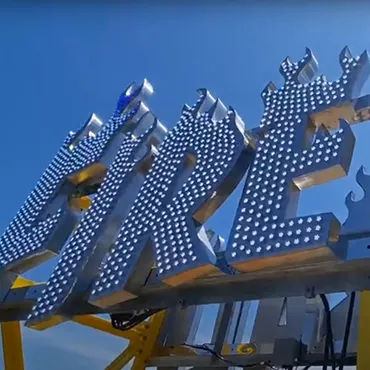
Aluminum is the most common return material in the sign industry, and for good reason. It is:
Easy to fabricate: Aluminum bends smoothly on a letter bending machine, can be cut cleanly with standard tools, and is easily welded or riveted. The return-forming step — which requires consistent, smooth curves — is far easier with aluminum than stainless steel.
Lightweight: Aluminum density is approximately 2,700 kg/m³ vs. stainless steel’s 7,900 kg/m³. A typical aluminum channel letter sign weighs roughly one-third of the equivalent stainless steel construction. This reduces structural requirements for the mounting wall.
Corrosion resistant: Aluminum naturally forms an oxide layer that prevents further corrosion. With powder-coat finishing, aluminum returns are highly durable in outdoor environments.
Paintable to any color: Powder coating allows aluminum returns to be finished in any RAL color, enabling precise brand color matching.
Cost: Lower cost than stainless steel — both material cost and fabrication labor.
Limitations of aluminum:
⦁ Cannot achieve the premium metallic appearance of brushed stainless steel
⦁ The “look” is primarily determined by the powder coat — no natural metallic character
⦁ Mirror finishes are possible (anodized aluminum) but not as sharp or durable as polished stainless
Stainless steel letters occupy the premium end of the channel letter market. The distinctive brushed or mirror-polished stainless finish is immediately recognizable as high-quality and is a strong design statement in its own right.
Premium visual character: Brushed 304 stainless steel with hairline finish, or mirror-polished stainless, conveys quality and permanence that no powder-coated aluminum can replicate. This is the preferred material for luxury hotel signage, high-end retail, premium hospitality, and corporate headquarters reception lettering.
Superior corrosion resistance: 304 stainless steel (18% chromium, 8% nickel) resists corrosion effectively in most outdoor environments. For coastal or marine environments, 316 stainless steel (with additional molybdenum) provides further corrosion resistance.
Long lifespan: Properly maintained stainless steel channel letters can last 20+ years without significant degradation. Aluminum with powder coat typically lasts 10-15 years before the coating requires renovation.
Halo-lit compatibility: Brushed and polished stainless steel surfaces are ideally suited to halo illumination. The metallic surface catches and diffuses the halo light in a distinctive way that aluminum and powder-coated surfaces cannot match.
Limitations of stainless steel:
⦁ Fabrication complexity: Stainless steel is harder to bend, requiring higher-capacity equipment and more skilled operators. Welding stainless requires TIG welding rather than the simpler MIG welding used for aluminum.
⦁ Weight: Stainless steel returns are approximately 3× heavier than equivalent aluminum returns. This requires more robust mounting systems.
⦁ Fingerprints: Brushed stainless shows fingerprints clearly. In high-contact applications (near reception desks, low-mounted signs), fingerprint marks require regular cleaning.
⦁ Cost: Stainless steel material cost and fabrication labor are both higher than aluminum — typically 40-80% more expensive per letter.
| Factor | Aluminum | Stainless Steel |
| Visual premium | Moderate (depends on paint finish) | High (metallic finish) |
| Weight | Light (2,700 kg/m³) | Heavy (7,900 kg/m³) |
| Fabrication difficulty | Low | High |
| Color options | Unlimited (powder coat) | Limited to metallic variants |
| Halo lighting suitability | Acceptable | Excellent |
| Corrosion resistance | Good | Excellent |
| Lifespan (outdoor) | 10-15 years | 20+ years |
| Relative cost | 1.0× | 1.4–1.8× |
| Best application | Retail, QSR, standard commercial | Luxury, hospitality, corporate |
Choose aluminum when:
⦁ The brand color requires a specific non-metallic color (blue, red, green brand colors are best achieved with powder coat)
⦁ Budget is a constraint
⦁ The installation does not benefit from the premium metallic aesthetic
⦁ Weight is a concern (high-mounted signs; older building facades with limited load capacity)
Choose stainless steel when:
⦁ The brand identity is premium or luxury
⦁ Halo (back-lit) illumination is required for the distinctive halo aesthetic
⦁ The metallic return is a visible part of the daytime sign design
⦁ Long-term durability and minimal maintenance are priorities